


Control system as the most core component of the environmental test equipment, its control precision directly affects the accuracy and credibility of the environmental test done by the equipment. At present, the application of environmental test equipment control system is mainly divided into general-purpose and specialized type. One of the general-purpose control system refers to the traditional human-machine interface (HMI) and programmable controller (PLC) combination of control methods, or industrial PC configuration software and PLC combination of control methods; dedicated controller refers to the control characteristics of different environmental testing equipment developed for the special controller. Domestic special environmental equipment controller field relative to foreign countries is relatively blank, which is also caused by the domestic environmental test equipment accuracy and stability is generally inferior to the main reasons for foreign environmental equipment, so the development of special controllers for the development of domestic environmental test equipment is of considerable significance.
1 . Design principle
In this paper, the environmental equipment control system is mainly oriented to the temperature class environmental test equipment, such as high temperature test chamber, high and low temperature test chamber, cold and thermal shock test chamber, constant temperature and humidity box, humid and hot box. And the temperature class environmental test equipment usually consists of the main box, heating system, refrigeration system, wind circulation system, the main control system, as shown in Figure 1.
The main control objects of the whole equipment include: refrigeration compressor, electronic expansion valve and control of cold discharge solenoid valve in the refrigeration system; centrifugal fan of the wind circulation system; heating system in the solid state relay and AC contactor.
The main measurement parameters of the whole device include: the temperature and pressure of the compressor exhaust gas in the refrigeration system, condenser outlet temperature, evaporator inlet and outlet temperature, compressor operating current and voltage; wind circulation system fan temperature, operating current and voltage; heating system in the electric heater operating voltage and current; temperature and humidity inside the box and so on.
In the above measurement parameters, some of the parameters and the control process of the equipment does not have a direct relationship, such as the compressor and fan operating voltage and current, fan speed and wind speed. However, with the rapid development of modern science and technology and industrial information technology, in aerospace, aviation, industrial applications and other areas of equipment and systems for reliability, safety and economic requirements are increasingly high, prompting the failure prediction and health management (Prognostics and Health Management, PHM) has gradually become one of the mainstream development direction of industrial equipment. However, the PHM system needs to be built on the basis of comprehensive monitoring of the operating conditions of the equipment, and the use of general-purpose PLC control system, too much parameter acquisition means the increase of PLC modules, which not only improves the manufacturing cost of the equipment, but also makes the equipment control system volume become bloated. To this end, this paper proposes an embedded-based control system, through the use of embedded systems to develop a high℃of freedom, low cost, targeted, real-time, high℃of integration of the program, the realization of the equipment's entire operating parameters monitoring; and easier to achieve complex algorithms, to improve the control accuracy and stability of the equipment, such as fuzzy PID control algorithms of the equipment, the average of the anti-impulse interference filtering, the limiting average filtering Digital filtering algorithms such as anti-impulse interference average filtering, limiting average filtering method.
2. Control system hardware design
Control system consists of a controller and measurement and control module; which measurement and control module including I / O module and measurement module, are modular design, the configuration of the equipment required for the modular increase or decrease; and the controller only for different configurations of the device to make the appropriate software settings or adjustments. This not only low-cost acquisition of equipment operating parameters; but also to improve the integration of the control system, reduce the size of the control module. Control system hardware framework shown in Figure 2, the controller to obtain the measurement module will be collected by the machine parameters, according to the control settings on the I / O module for I / O and PID control output.
Controller and I / O module, measurement module based on the 485 interface Modbus protocol communication. As Modbus bus is widely used in many fields such as instrumentation, intelligent high and low voltage appliances, transmitters, programmable controllers, HMIs, inverters, field intelligent devices, etc., it makes the controller and the I/O modules, measurement modules have great expandability and the possibility of becoming products independently.
2.1 Controller hardware design
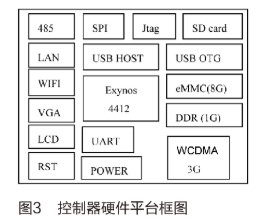
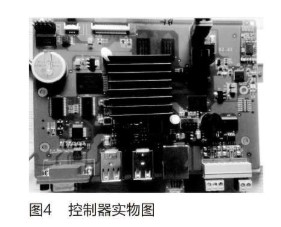
The embedded controller is based on the ARM Cortex-A9 quad-core microprocessor hardware development platform, is mainly responsible for the control system in the operation of the human-machine interface, logic operations, I / O and PID control. The Exynos4412 processor used in the hardware platform has high-performance data processing capabilities and a more complete hardware interface, which provides a good hardware foundation for building Linux embedded systems. The functional block diagram of the controller hardware development platform is shown in Figure 3, with on-board WIFI, 3G module, 10M/100M adaptive network card, 10.1-inch touch LCD, 4-channel USB HOST and so on.
The hardware platform supports startup from eMMC or SD card. eMMC is used to burn system image, so the controller starts from eMMC by default after power on; while SD card startup function can be used with USB OTG to realize fast upgrade of firmware and system software. wifi, wcdma 3g, lan and other network interfaces are used to connect the controller to the internet in different cases, which can be used for remote control, remote fault warning or alarm, remote control, remote fault warning or alarm, remote control, remote fault warning or alarm, remote fault warning or alarm, remote fault warning or alarm, and remote control. WIFI, WCDMA 3G, LAN and other network interfaces are used to connect the controller to the Internet under different circumstances, providing hardware support for the realization of remote control of equipment, remote fault warning or alarm, expert remote troubleshooting and other new applications.
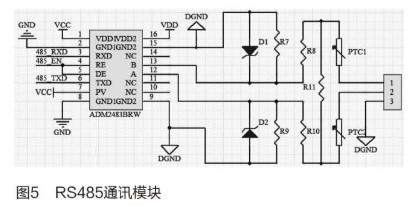
In order to ensure that the controller can realize high-speed real-time reliable communication with the measurement and control board, the controller two RS485 communication circuit design are based on the ADM2483. ADM2483 is an integrated communication isolation RS485 transceiver device, the highest communication rate of up to 500kbps, in order to ensure that the communication rate and the ability to resist interference under the premise of avoiding the use of opto-coupler isolation design needs to take up a larger PCB layout area. Layout area. And ADM2483 used to limit the swing rate design, the pressure swing rate drop control at an appropriate level, can reduce the improper terminal matching and connectors generated by the BER. The interface circuit of the communication module adopts the design of current and voltage limitation, as shown in Figure 5, voltage regulator D1, D2 and self-recovery fuses PTC1 and PTC2 to the interface circuit to form an effective protection to improve the electrical reliability of the 485 communication module.
2.2 Hardware design of measurement and control module
The hardware block diagram of the measurement and control module is shown in Figure 6, with LPC1758 as the core, responsible for the acquisition of device operation data, I/O address decoding and I/O control; the relevant temperature, current, voltage, humidity, pressure and other parameters of the device through the acquisition circuit, and then by the LPC1758 digital filtering, stored in the FLASH; the controller can communicate with the LPC1758 through RS485, read the required parameters for logic operations, and then the I/O control commands to the LPC1758 execution after operation; I/O circuits include transistor outputs, relay outputs, and then the I/O control command to the LPC1758 execution. The controller can communicate with LPC1758 through RS485, read the required parameters for logic operation, and then send the I/O control commands to LPC1758 for execution after the operation.I/O circuit includes transistor output, relay output and output for special applications, such as electronic expansion valve control I/O, frequency converter control I/O and so on.
The filter sampling circuit uses Maxim's single-channel 24-bit ADC MAX11210, which integrates analog and reference input buffer amplifiers and provides four GPIO ports that can be used to control an external 16-channel analog switch, which makes the MAX11210 efficiently collect 16-channel analog signals and reduces the burden on the LPC1758's I/O resources. The sampling circuit block diagram is shown in Figure 7. The sampling circuit block diagram is shown in Figure 7.
Finally, in order to ensure the accuracy and reliability of the I/O circuit, the I/O state detection design is added to the hardware circuit. For the output point, the I/O state detection circuit generates the corresponding Output sequence signal from the output state, and when the controller's command to change the output state is sent to the LPC1758 and executed, the state of the output point is changed, and the LPC1758 compares the changed Output sequence signal with the output command issued by the controller to ensure the accuracy of the output; whereas, for the input point, it produces the When the input state is changed, LPC1758 compares the actual input state with the Input sequence signal to determine whether the input circuit is in error.
3. Control System Software Design
In order to meet the controller multi-hardware interface, multi-software program application development, multi-file operation, system customization and other requirements, the Linux embedded operating system, the main application program has a human-machine interface program, data processing program, soft PLC program, as shown in Figure 7. Among them, the HMI program is generated by the graphical software running under the Windows environment through the combination of graphical elements, controls and macro commands, which can be imported to the controller via USB to realize the update of the HMI. The data processing program is mainly responsible for equipment industrial control record, PID operation, equipment status monitoring and other functions. The soft PLC program is developed by Infoteam OpenPCS software from Germany, which supports six IEC languages, namely ST, IL, SFC, FBD, LD and CFC, and is responsible for I/O logic operation.
Since the measurement and control module does not need too many applications and graphical interfaces, uC/OS-II, which is much smaller relative to the Linux embedded operating system organization, is chosen. the system is feature-rich, covering functions such as task scheduling, task management, time management, memory management and inter-task communication and synchronization [6]. The main applications are data acquisition program, I/O detection program, and I/O control program. The whole I/O control flow is shown in Figure 9. If there is an I/O circuit error alarm, the user can choose to power down and restart the device or request technical support.
4 Conclusion
The embedded environmental test equipment control system designed in this paper, its controller and measurement and control module have the advantages of low cost, high integration, high precision, expandability and so on, which can improve to a certain extent the characteristics of environmental test equipment such as small batch size and many varieties of the adverse effects on the design and production. And by fully utilizing the advantages of our company's production of environmental test equipment, we can continuously improve the reliability of the control system design through environmental testing. The control system is now used in our standardized series of environmental equipment, control accuracy and stability have reached the domestic advanced level, and hardware configuration is rich, with a good ability to expand.